

The International Youth Day, 12/08/2026 Highlighting the Situation of the Youth in the Palestinian Society
Palestinian Central Bureau of Statistics (PCBS)
On the Occasion of the International Youth Day, the Palestinian Central Bureau of Statistics (PCBS) Issues a Press Release Highlighting the Situation of the Youth in the Palestinian Society
“The Youth of Palestine: Different Contexts, Common Aspirations"
The United Nations General Assembly, in its Resolution No. 54/120 of 1999, approved the declaration of August 12th as the International Youth Day, as they are essential partners in change, and with the aim of raising awareness and shedding light on the challenges and problems facing the young people all over the world.
The world celebrates International Youth Day 2026, which this year comes under the theme "Different Contexts, Common Aspirations," emphasizing that the young people, regardless of their environments and circumstances, share common aspirations for dignity, opportunity, meaningful participation, decent work, quality education, and a sustainable future.
In Palestine, this theme takes on a particular significance given the exceptional circumstances faced by the Palestinian youth as a result of the ongoing Israeli occupation and aggression against Gaza Strip, and the escalating violations in the West Bank, with their profound impact on all aspects of their lives. Despite these challenges, the Palestinian youth continue to play their role as an active force in society and a fundamental pillar of resilience, development, and reconstruction.
Opportunities... The Youth are a Demographic Asset Requiring Investment
The Palestinian youth represent the nation's greatest asset and its most important human capital. Their high percentage of the total population presents a demographic opportunity that can accelerate development if the appropriate environment is secured to invest their energies.
Population estimates indicate that the Palestinian population residing in the State of Palestine reached approximately 5.56 million by the end of 2025, of whom 3.43 million (61.7%) lived in the West Bank and 2.13 million (38.3%) lived in Gaza Strip.
The number of the Palestinian youth aged 18–29 is approximately 1.2 million, representing about 21% of the total population of Palestine, with 22% in the West Bank and 21% in Gaza Strip. The number of the young people in the West Bank reached 731,764 compared to approximately 444,000 in Gaza Strip at the end of 2025.
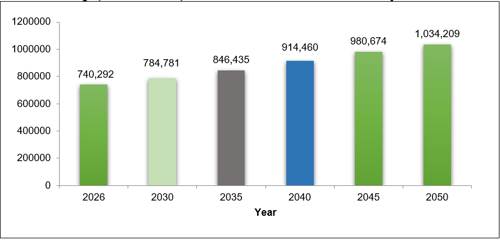
Population estimates indicate continued growth in the number of the young people in the West Bank over the coming decades. It is expected that their numbers will rise from 731,764 in 2025 to more than 1,034,209 by 2050.
Estimated population in the age grow
up (18-29 Years) in the West Bank for selected years
These indicators underscore the importance of adopting national policies that invest in youth as the driving force for economic and social development by securing a safe environment, enhancing educational and training opportunities, supporting entrepreneurial initiatives, and expanding opportunities for economic and social participation.
Dignity... the Palestinian Youth Pay the Price of Aggression and Cling to their Right to Life
Although the youth group represents one of the most important pillars of Palestinian development, it has been among the most affected by the ongoing Israeli aggression since October 7th, 2023.
In Gaza Strip, more than 73,386 Palestinians have been martyred as of August 11, 2026, with data indicating that the young people constitute approximately 24% of the total number of martyrs (comprising 26% males and 22% females). The number of martyrs in the West Bank reached 1,183, 71% of whom were under the age of 30. The effects of the aggression were not limited only to human losses, but also extended to forced displacement, loss of homes, disruption of education, reduced job opportunities, and increased levels of psychological and social pressures. This has left the Palestinian youth facing unprecedented challenges that infringe upon their right to life, dignity, and security.
Despite the difficult circumstances that the Palestinian youth are facing, they possess great capabilities for innovation, creativity, and resilience, which makes investing in this group a strategic option to ensure the achievement of sustainable development and enhance the ability of the Palestinian society to get recovered and rebuilt.
Active Participation: The Palestinian Youth are Partners in Development and Digital Transformation
Active participation is one of the most important aspirations of the young people. It is no longer limited to community involvement and decision-making, but now also includes integration into the digital economy, leveraging technology, and accessing knowledge and innovation.
The results of the Labor Force Survey for the first quarter of 2026 indicate that 97.7% of the young people aged 18–29 in the West Bank use the internet from anywhere (97.0% among males and 98.5% among females). This reflects the widespread use of the internet among the Palestinian youth.
The data also showed that 96.8% of the young people own mobile phones (97.1% among females and 96.4% among males). Smartphone ownership reached 96.7% (97.1% among females and 96.4% among males).
These indicators align with the Sustainable Development Goals, particularly Goal 5 on promoting the use of enabling technologies for women (5.b.1) and Goal 17 on promoting the use of information and communication technologies and capacity building in science, technology, and innovation (17.8.1).
Despite this high level of access to technology, achieving effective participation requires transforming the widespread use of technology into real opportunities for creativity, innovation, entrepreneurship, and remote work. This will enhance the role of the youth in economic and social development and enable them to contribute more effectively to building the future of the State of Palestine.
Decent Work: Unemployment Remains the Biggest Challenge Facing the Palestinian Youth
Access to decent work is one of the most important aspirations of the Palestinian youth. However, data indicate that unemployment rates remain high, particularly in Gaza Strip, which limits their ability to achieve economic independence and contribute to development.
In 2025, the unemployment rate among the young people participating in the labor force (aged 15–29) reached approximately 85.5% in Gaza Strip, compared to 37.3% in the West Bank. This reflects the significant impact of economic and humanitarian conditions on employment opportunities, especially in Gaza Strip.
Young women recorded the highest unemployment rates in both the West Bank and Gaza Strip, reaching 46.5% in the West Bank and 94.0% in Gaza Strip, compared to 34.8% among young men in the West Bank and 81.3% in Gaza Strip. These indicators highlight the persistent gender gap, with young women facing greater challenges in accessing employment opportunities.
At the educational level, the unemployment rate among young graduates with academic degrees reached 42.5%, compared to 29.8% among vocational training graduates. This indicates that graduates of vocational education and training have relatively better opportunities to integrate into the labor market.
Females recorded the highest unemployment rates among graduates with academic degrees, reaching 52.7%, compared to 30.2% among males. The unemployment rate among female vocational training graduates was 35.0%, compared to 28.9% among males.
These results underscore the need to realign educational outcomes with labor market needs, strengthen vocational and technical education and training, guide students toward in-demand specializations, adopt more effective economic policies to create sustainable job opportunities, support entrepreneurial projects, and empower young women economically. This will contribute to investing in Palestinian human capital and reducing the gender gap.
Quality Education: Investing in the Youth Despite the Challenges
Education is one of the most important pillars of development in the Palestinian society, as it has always been the most sustainable investment in building human capital and enhancing capabilities. Data from 2025 indicate that out of every 100 young men and women aged 18–29 in the West Bank, 19 hold a bachelor's degree or higher. Young women continue to outperform young men in academic achievement, with 25 out of every 100 young women holding such degrees, compared to 14 out of every 100 young men.
However, the Israeli aggression has cast a heavy shadow on the education sector. Between October 7th, 2023, and July 7th, 2026, 1,422 students enrolled in higher education institutions in Palestine were martyred (1,383 in Gaza Strip and 39 in the West Bank). The number of injured students enrolled in Palestinian higher education institutions reached 3,350 (3,067 injured in Gaza Strip and 283 in the West Bank). More than 492 students enrolled in West Bank universities were also detained.
These figures underscore that protecting the right to education and preserving educational institutions are fundamental priorities to ensure that an entire generation of the Palestinian youth is not lost and to safeguard the human capital that forms the basis of national development.
A Sustainable Future: Empowering the Youth is the Foundation of Development and Reconstruction
Achieving a sustainable future requires not only providing education and employment opportunities but also ensuring the continued integration of the young people into education, training, and the labor market.
Data indicate a decrease in the percentage of the young people (aged 15–29) not in employment, education, or training (NEET) in the West Bank, from 39.4% in 2024 to 37.1% in 2025.
Despite this improvement, young women remain more likely to be outside employment, education, or training, with a rate of 44.6% compared to 29.9% among young men. The percentage also decreased among young men from 32.6% to 29.9%, and among young women from 46.5% to 44.6% during the same period.
These results indicate that more than a third of the young people in the West Bank are still outside work, education, or training, which calls for expanding vocational and technical training programs, enhancing digital skills, linking education outputs to labor market needs, and securing a supportive environment for innovation and entrepreneurship, enabling young people to contribute effectively to development and rebuilding the Palestinian economy.
The Palestinian Youth: Shared Aspirations Despite Differing Circumstances
The Palestinian youth represent the most important human capital, constituting more than one-fifth of the society. They possess good levels of education and significant capabilities for resilience, innovation, and creativity. However, the ongoing aggression, high unemployment rates, declining economic opportunities, and the targeting of the education sector all pose real challenges to realizing their aspirations.
Despite the differences between the Palestinian context and many other countries, the aspirations of the Palestinian youth remain consistent with those of the young people worldwide: to live in dignity, have equal opportunities, participate actively in society, access decent work and quality education, and a more sustainable future.
On the occasion of the International Youth Day, the Palestinian Central Bureau of Statistics affirms that investing in the youth, protecting their rights, strengthening their resilience, and empowering them economically and socially is an investment in the future of the State of Palestine and a fundamental requirement for achieving sustainable development and building a more resilient and prosperous society.