

The World Environment Day , 05/06/2026
The Palestinian Central Bureau of Statistics (PCBS) and the Environment Quality Authority (EQA) issue a joint press release on World Environment Day under the theme "A Global Call for Climate Action"
Since 1972, the world has marked World Environment Day on the fifth of June each year as an international occasion to highlight pressing environmental issues and strengthen efforts aimed at protecting natural resources and achieving the Sustainable Development Goals. This year’s theme is: “A Global Call for Climate Action.”
This occasion underscores the importance of addressing the impacts of climate change and enhancing environmental resilience in Palestine amid growing challenges caused by global warming, in addition to exceptional circumstances including the ongoing Israeli occupation, military restrictions and checkpoints, the continuing aggression against Gaza Strip, and settlers’ violence in the West Bank.
Palestine strengthens its climate commitments through preparations for the third nationally determined contributions report
The State of Palestine continues its commitment to the United Nations Framework Convention on Climate Change (UNFCCC) and the Paris Agreement by enhancing the preparation and implementation of national reports, foremost among them the Nationally Determined Contributions (NDCs) report. The NDCs serve as a key instrument for guiding climate action, strengthening adaptation efforts, supporting national policies, and attracting green investments.
Limited emissions… escalating climate impacts in Palestine
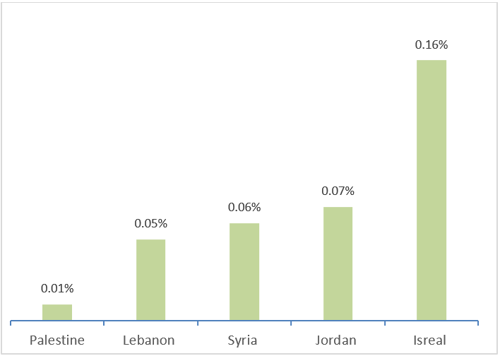
Despite the escalating environmental and climate challenges, Palestine’s contribution to global greenhouse gas emissions remains extremely limited. Palestinian national emissions are estimated to account for less than 0.01% of total global emissions — a negligible share compared to major industrialized countries. Nevertheless, Palestine is considered one of the most vulnerable and affected regions by the impacts of climate change. This reality reflects a state of “climate injustice,” whereby Palestine bears the consequences of a global climate crisis despite its very minimal contribution to causing it.
Ratio of national emissions to global emissions in the countries of the region, 2023
The carbon footprint of the Israeli occupation and the hidden climate cost
Recent scientific studies and analyses published in 2026 by the international journal One Earth[i], in collaboration with the Conflict and Environment Observatory (CEOBS), indicate that the total carbon footprint resulting from the ongoing war and aggression against Gaza Strip has exceeded 33.2 million tons of carbon dioxide equivalent, which is a massive figure comparable to the total annual emissions of an entire country, or what approximately 7.6 million gasoline-powered cars emit in one year.
This catastrophic environmental cost is divided between direct military operations, which produced about 1.9 million tons of emissions, and the carbon cost associated with debris removal and the reconstruction of destroyed buildings and homes, estimated at around 29.8 million tons.
An increase of more than 600% in the prices of water tankers
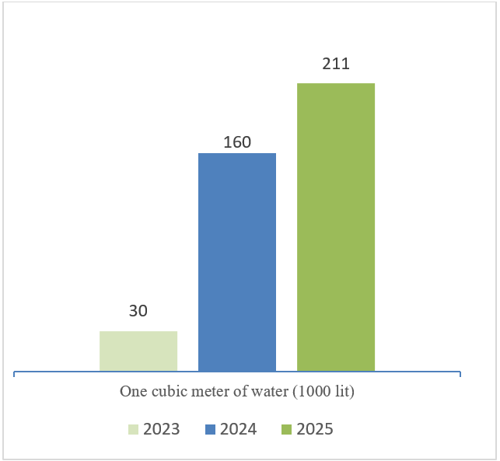
The destruction of water networks in Gaza Strip has led to a sharp increase in water prices, particularly for water distributed by tankers. The price of one cubic meter of water rose to approximately 211 shekels in 2025, compared to 30 shekels in 2023, reflecting the worsening water crisis and the growing economic burden on citizens.
Price of drinking water (in NIS) distributed by tankers in Gaza Strip during 2023-2025
Widespread destruction of Gaza’s sewage infrastructure and escalating public health threats
Gaza Strip is experiencing a near-total collapse of its sewage system as a result of the damage made to more than 90% of the infrastructure and the destruction of all wastewater treatment plants. Extensive damage was also recorded to sewage networks (approximately 1,545 km) and 47 pumping stations. With the continued electricity and fuel shortages, services have come to a complete halt, leading to the overflow of wastewater into streets, increasing environmental and public health risks, and accelerating the spread of diseases.
Escalating environmental pollution in Gaza amid the growing waste and rubble crisis
Gaza Strip is witnessing a severe environmental deterioration due to the accumulation of approximately 710,000 tons of household waste and nearly 60 million tons of rubble generated by the destruction of more than 330,000 housing units. This comes amid the near-total collapse of waste collection services and the destruction of 90% of municipal equipment, contributing to the spread of pollution and diseases, worsening the environmental crisis, and complicating recovery efforts.
86% of agricultural lands in Gaza Strip were destroyed
A recent report by UNOSAT up to the end of June 2025 revealed that the Israeli aggression caused widespread destruction to Gaza’s agricultural sector, with around 86% of agricultural land destroyed due to bombardment, land leveling, and military vehicle movements. Higher levels of destruction were recorded in some areas, with the percentage rising to 94% in North Gaza, alongside further increases in Gaza Governorate compared to previous assessments. This rapid and ongoing collapse of the agricultural sector represents a direct and severe threat to food security for more than two million people in Gaza Strip.
Percentage of agricultural lands destroyed by the Israeli aggression against Gaza Strip by governorate until 31/07/2025
|
% of destroyed agricultural land |
Governorate |
|
94 |
North Gaza |
|
91 |
Gaza |
|
84 |
Dier Al-Balah |
|
81 |
Khan Yunis |
|
79 |
Rafah |
|
86 |
Gaza Strip |
Escalating Israeli environmental violations threaten ecosystems in the West Bank
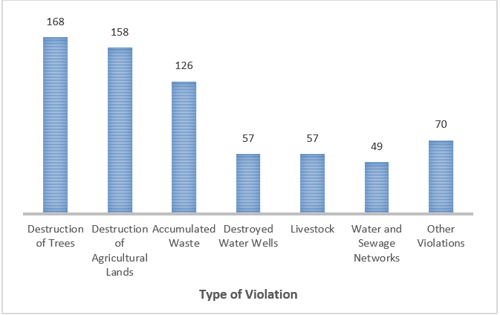
2025 witnessed a significant escalation in Israeli environmental violations in the West Bank, with 685 violations recorded compared with 535 violations in 2024. By the end of April 2026, 310 violations had already been documented, reflecting the increasing assaults on the Palestinian environment. These violations included the leveling of agricultural lands, destruction of trees, discharge of wastewater, dumping of solid waste, and damage to infrastructure, leading to growing degradation of ecosystems and threatening the sustainability of natural resources.
Number of Israeli environmental violations in the West Bank by type during 2025
Climate action in Palestine is not merely an environmental issue; it is a matter of resilience, steadfastness, and the right to life, resources, and sustainable development
Despite the catastrophic state of the Palestinian environment, there are still signs of hope and resilience, highlighted by the following:
- The Environment Quality Authority signed contracts to support environmental and agricultural initiatives for nine institutions, with the aim of enhancing resilience and sustainable development, protecting biodiversity, promoting climate change adaptation, and empowering local communities.
- The number of environmental clubs in schools across the West Bank increased to 851 clubs in 2025/2026, compared to 591 previously, marking an increase of 260 clubs (44%), which reflects growing environmental awareness.
- The electricity generation capacity from solar cells in Palestine rose to 400 megawatts by the end of 2025, compared to 300 megawatts in 2023, contributing 8% of total electricity generation as part of efforts to promote clean energy and energy security.
- A joint water-energy sector project received funding of USD 620,000. The project aims to prepare feasibility studies and develop a roadmap for investing in solar energy systems for priority water sector facilities.
- Within the framework of the Twinning Project implemented in cooperation with a Lithuanian-Austrian consortium:
- Work is underway to prepare a draft of the new Environmental Law under the title “Environmental Law within the Framework of Sustainable Development,” aimed at strengthening the environmental system in line with international standards.
- A guideline is being developed to integrate environmental and climate change dimensions into all sectors, including agriculture, local governance, and water.
- The Municipal Development and Lending Fund was accredited in 2026 as a national direct access entity to the Green Climate Fund.
- Palestine recently joined the Adaptation Fund, a leading international financial mechanism specialized in strengthening climate resilience in Palestine.
[i] https://www.cell.com/one-earth/fulltext/S2590-3322(26)00049-7