

On the occasion of the International Workers' Day, 2026 (PCBS), presents the current status of the Palestinian labour force in 2025
Palestinian Central Bureau of Statistics (PCBS)
On the occasion of the International Workers' Day, (PCBS), presents the current status of the Palestinian labor force in 2025
“A Sharp Deterioration in Palestinian Labor Conditions Following the Israeli Aggression against Gaza Strip”
On the occasion of International Workers’ Day, PCBS highlights the profound transformations in the Palestinian labor market following the Israeli Aggression against Gaza Strip, and the sharp deterioration in workers’ conditions across both Gaza Strip and the West Bank.
Prior to October 7th, 2023, the Palestinian economy was navigating structural challenges and dependency constraints, while showing modest signs of stabilization—particularly through increased employment of Palestinian workers inside Israel and Israeli settlements. However, the Israeli aggression against Gaza Strip has resulted in an unprecedented economic and labor market shock, fundamentally altering these trends.
In the West Bank, economic activity has been severely disrupted by intensified movement restrictions, fragmentation between governorates, and the near-total denial of access to jobs inside Israel. As a result, total employment declined from approximately 868,000 workers in the third quarter of 2023 to about 736,000 in the fourth quarter of 2025, representing a decrease of 15%. This contraction has been most pronounced in the construction sector, followed by mining and manufacturing, and transportation, storage, and communications.
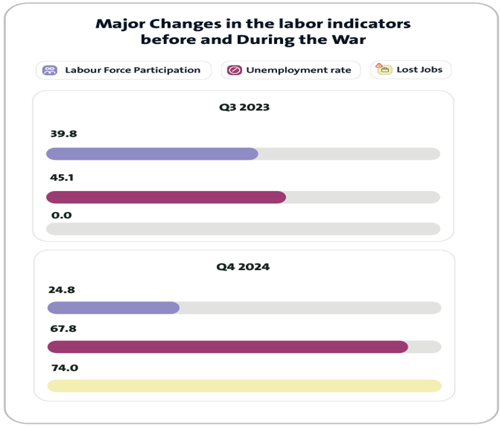
The situation in Gaza Strip has been catastrophic. Labor market indicators reveal a near-collapse, with unemployment rates rising to approximately 68% in the fourth quarter of 2024, compared to about 45% prior to the Israeli aggression. Labor force participation has simultaneously declined to around 25% compared to 40% in the 3rd quarter 2023, while the percentage of employed who lost their jobs due to Israeli aggression to be unemployed or outside labour force reached 74% in the 4th quarter 2024 reflecting widespread exclusion from economic activity.
Youth 15–29 not in employment, education, nor training. Have been disproportionately affected, with approximately 74% .
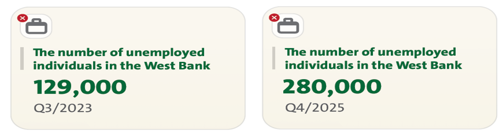
The repercussions of the Israeli aggression have extended beyond Gaza into the West Bank. The number of unemployed individuals more than doubled, increasing from approximately 129,000 in the third quarter of 2023 to about 280,000 in the 4th quarter of 2025.
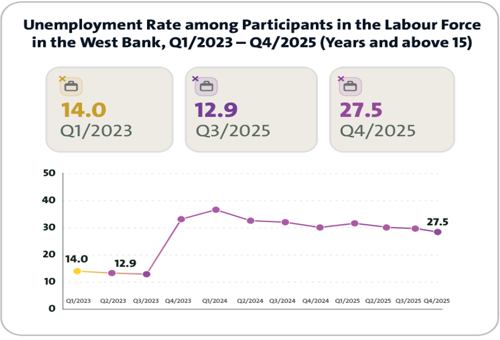
Consequently, the unemployment rate rose from approximately 13% to 28% during the same period.
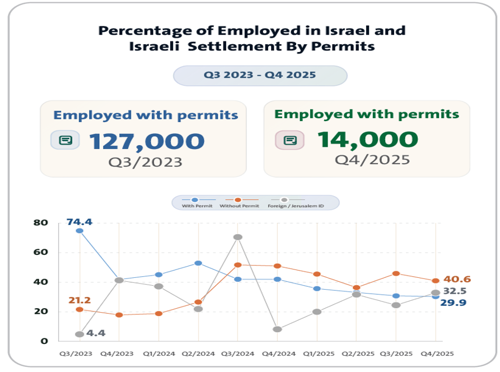
Employment in Israel and Israeli settlements has also experienced a sharp decline due to post-Israeli aggression closures and restrictions. The number of West Bank workers employed in these areas fell sharply from approximately 172,000 prior to the Israeli aggression to just 25,000 in the fourth quarter of 2023, before partially recovering to about 51,000 by the fourth quarter of 2025. The most significant reduction was among workers holding official permits, whose numbers dropped from approximately 127,000 to just 14,000.
Informal employment remains a defining feature of the labor market in the West Bank. By the fourth quarter of 2025, approximately 60% of workers were engaged in informal employment, lacking access to basic labor protections such as pensions, end-of-service benefits, and paid leave. This rate is notably higher among men compared to women.
Wage levels have also deteriorated. The average real daily wage in the private sector declined to approximately 120 NIS in the fourth quarter of 2025, down from 126 NIS prior to the Israeli aggression. Sectoral disparities persist, with transportation, storage, and communications recording the highest wage levels, while agriculture remains the lowest-paid sector.
Furthermore, a growing proportion of workers earn below the minimum wage. Approximately 14.6% of private sector employees—equivalent to around 40,000 workers—received less than the official monthly minimum wage of 1,880 NIS in the fourth quarter of 2025.
Despite these challenges, labor rights coverage remains limited. Only about 40% of private sector employees in the West Bank benefit from basic employment rights, including pension fund schemes, end-of-service compensation, and paid leave. The number of paid employees in the private sector with permanent employment contracts (written for an indefinite period) reached around 62,000, while approximately 127,000 private sector workers had temporary contracts (written for a fixed period or verbal agreements). In contrast, about 134,000 workers had no employment contract. Meanwhile, 47% of female wage earners received paid maternity leave in the fourth quarter of 2025, compared to 51% in the third quarter of 2023.