 عربي
عربي
The Palestinian Central Bureau of Statistics (PCBS)
highlights the situation of Palestinian children on the Occasion of
the Palestinian Child Day, 05/04/2026.
Palestinian Children: 2.47 Million Beating Hearts and Existential Resilience in the Face of Challenges
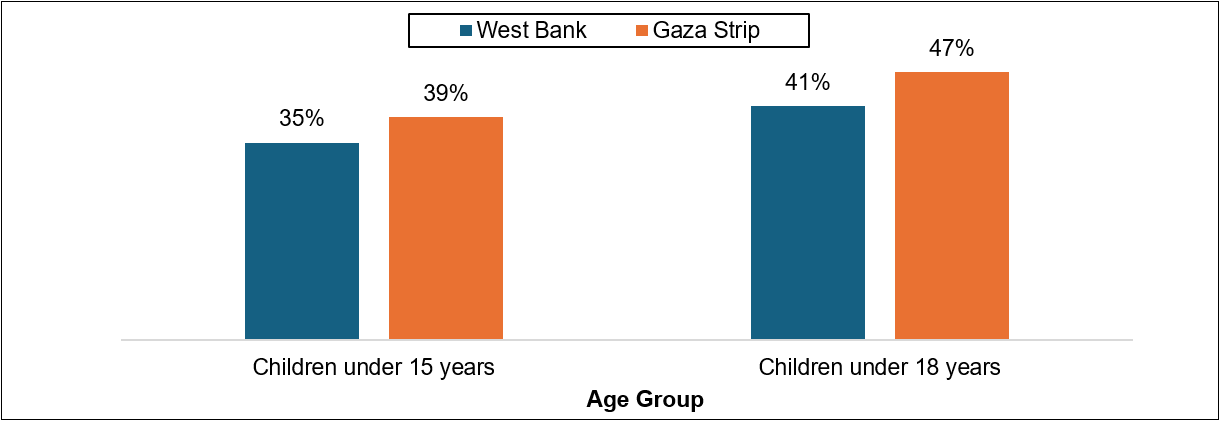
Demographic estimates indicate that the population of the State of Palestine reached approximately 5.56 million by the end of 2025 (3.43 million in the West Bank and 2.13 million in Gaza Strip). The Palestinian society is characterized by being a young demographic structure, as children under the age of 18 constituted 43% of the total population, approximately 2.47 million children (1.38 million in the West Bank (41%) and 1.09 million (47%) in Gaza Strip) at the end of 2025. The age group under 15 years accounted for 36.3% of the total population, around 2.02 million children (1.18 million in the West Bank (35%) and 0.83 million (39%) in the Gaza Strip).
Percentage of Children in Palestine by Region and Age Group, End of 2025
Between Bombing, Hunger, and Cold: The Coalition of Death Steals Palestinian Childhood
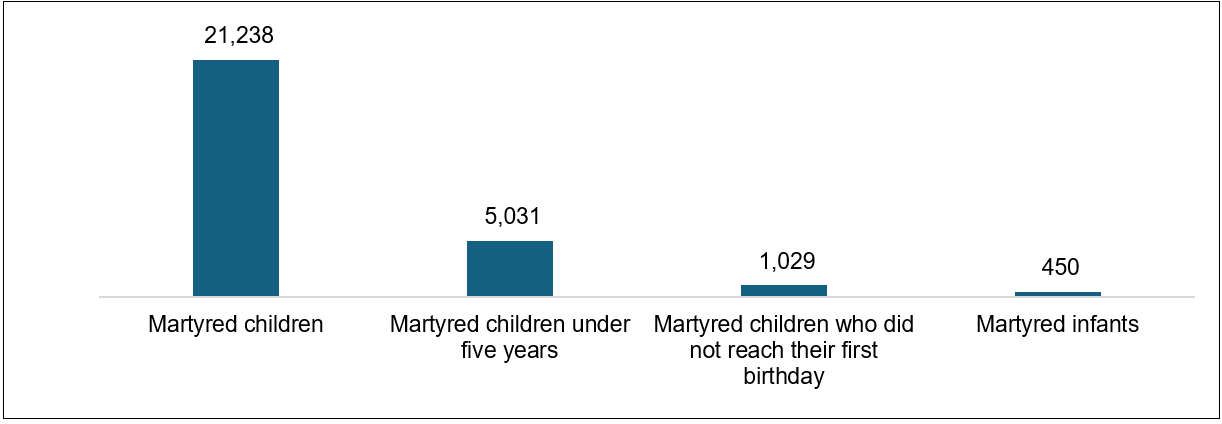
Palestinian Child Day this year falls amid one of the most severe humanitarian disasters of the modern era, as the ongoing Israeli aggression against Gaza Strip (October 7th, 2023 – April 1st, 2026) has shown a systematic targeting of an entire generation’s future. The number of martyrs reached 72,289, including 21,283 children[1], who were martyred, accounting for approximately 30% of all victims by the end of 2025. Of whom, 450 were infants, and 1,029 were children under one year old, in addition to 5,031 children under five, reflecting a true extermination of a generation that had not yet begun life. The methods of killing were not limited to airstrikes alone; the combination of siege, hunger, and cold also claimed children’s lives. A total of 157 children died of starvation, 25 others perished from frost in displaced persons’ tents, and the fate of approximately 9,500 missing persons who were mostly children and women buried under rubble remains unknown, swallowed by debris without a witness or grave.
At the level of injuries, children are facing a dual health catastrophe. The number of injured persons has reached 172,040, including at least 44,486 children, representing 26% of the total number of injured. The physical consequences of the war remain devastating, with 10,500 children suffering life-altering injuries and more than 1,000 cases of limb amputations, amid a complete collapse of the healthcare system and a severe shortage of assistive devices.
Around 4,000 children are at risk of death unless urgent medical evacuation is secured. This bleeding crisis has also extended to the West Bank, where 237 children have been killed out of a total of 1,145 martyrs[2]. These figures confirm that what is happening constitutes a systematic attempt to annihilate an entire Palestinian generation, through a “coalition of death” that includes indiscriminate bombardment, forced starvation, suffocating siege, and the harsh cold of winter.
Number of Martyred Children in Gaza Strip by Selected Age Groups,
Up to December 31st, 2025
More than 1,655 cases of child arrests: Systematic Violation of Childhood Rights and a Flagrant Breach of International Law
A report issued by the detainee rights institutions[3], showed an unprecedented surge in the Israeli occupation arrests of Palestinian children. Since the outbreak of the war, human rights organizations have documented more than 1,655 cases[4] of child detention in the West Bank, including East Jerusalem, among them 600 cases recorded during 2025, which are clear breaches of the international law and the Convention on the Rights of the Child. As of March 11th, 2026, the Israeli occupation continues to detain 350 child prisoners, who are enduring harsh conditions, and deprivation of basic rights, within a systematic framework of grave violations.
58,000 Children in Gaza Strip Have Lost One or Both Parents: An Aggression Tearing Apart the Social Fabric and Creating the Largest Orphanhood Crisis
in Modern History
The tragedy is not limited to physical harm alone, but extends to the very fabric of the family and social structure, leaving deep and long-lasting impacts. According to the United Nations Children’s Emergency Fund (UNICEF)[5], more than 58,000 children in Gaza Strip have lost one or both parents as a result of the Israeli aggression, leaving them to face life under harsh conditions without household support or adequate care.
The Starvation War in Gaza Strip: Numbers Reveal a Silent Extermination
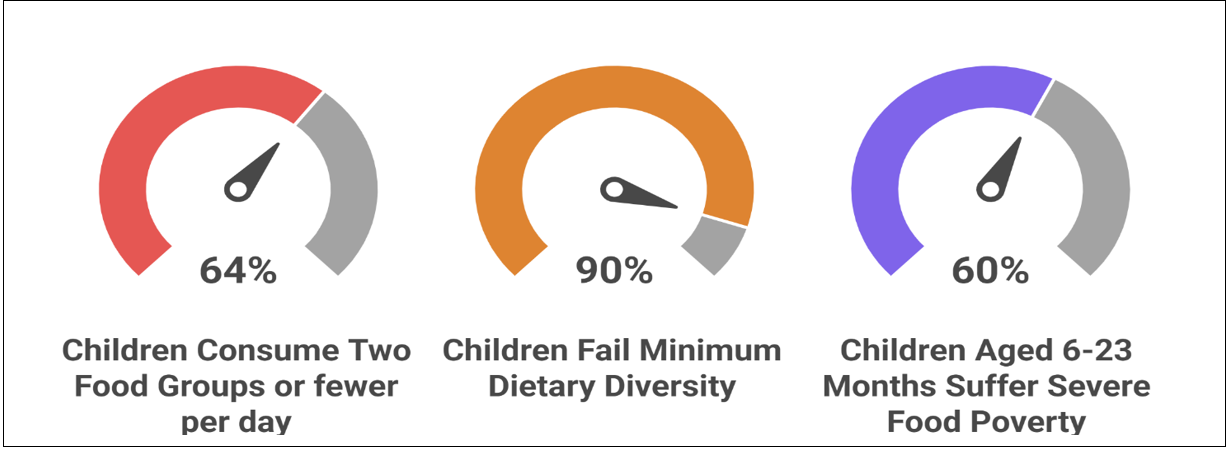
A report issued by the United Nations Office for the Coordination of Humanitarian Affairs (OCHA)[6] showed an unprecedented nutrition crisis in Gaza Strip, where famine has become a deadly weapon added to the tools of killing and targeting. In February 2026, more than 3,700 children (aged 6–59 months) were admitted for treatment of malnutrition, including over 600 children suffering from severe acute malnutrition. Although these figures show a slight decline compared to January, when they exceeded 4,600 children and 890 severe cases, they remain a stark indicator of the ongoing disaster. Data show that 64% of children consume only two food groups or fewer per day, while more than 90% fail to reach the minimum dietary diversity. Moreover, over 60% of children (aged 6–23 months) suffer from severe food poverty, threatening their essential growth.
Percentage of Children in Gaza Strip Suffering from Inadequate Dietary Diversity as of February 2026
This grim reality is not limited to the current reality, as projections for 2026 indicate that 37,000 pregnant and breastfeeding women will suffer from severe malnutrition, alongside 25,000 infants under six months, 101,000 children under five, and 120,000 children aged 5–17 who will require urgent therapeutic interventions, including 31,000 children at imminent risk of death due to severe acute malnutrition.
The tragedy is further compounded by the near-total collapse of the healthcare system, with approximately 94% of healthcare facilities damaged or destroyed due to hospital demolitions and the blockade on medical supplies. The remaining facilities are operating at extremely limited capacity and are unable to save lives.
From Bombed Homes to Tent Mines: A Double Threat Lurks Over Children in Gaza Strip Across 1,000 Displacement Sites
The catastrophe of infrastructure destruction in Gaza Strip goes beyond the loss of buildings, striking at the very core of children’s physical and psychological safety. With at least 320,622 housing units damaged or destroyed, hundreds of thousands of children have lost their rooms, toys, and safe spaces, finding themselves among 1.4 million displaced people, where two-thirds of the population lack even the most basic elements of human dignity. This widespread destruction has turned “home” into a distant memory, and “the torn tent” in over 1,000 overcrowded displacement sites[7] into a bitter reality devoid of privacy and protection from
the harshness of the climate. In this crumbling environment, children face a dual threat: while struggling against cold and hunger in nearly 800 informal tent clusters, they are also stalked by the “silent death” lurking in the remnants of war. Since October 2025, mine-related organizations have documented 33 explosions resulting in 9 deaths and 65 injuries, with children being the most affected victims. Those who survived direct bombardment now find themselves prey to explosive remnants left by the machinery of war among their tents and along displacement routes, turning the search for safety into a literal minefield that threatens their lives and future at every step.
Meanwhile, the United Nations Relief and Works Agency for Palestine Refugees (UNRWA) reported that over 12,000 Palestinian children in the West Bank are living under conditions of forced displacement due to the ongoing Israeli military operations in northern West Bank since early 2025. These operations began in Jenin camp and spread to Nur Shams and Tulkarm camps, displacing approximately 50,000 Palestinians. These children face deteriorating humanitarian and health conditions, including loss of stability and interruption of education, limited access to healthcare services, shortages of medicines, heightened risks of infectious diseases and malnutrition, as well as severe psychological impacts. Although UNRWA has launched an emergency education program to provide schooling and psychosocial support, these efforts remain limited in the face of the scale of the crisis, leaving the present and future of an entire generation under serious threat[8].
From Bombing to Arrest: How the Israeli Aggression Destroyed the Right to Education for a Whole Palestinian Generation
Education in Gaza Strip has become a primary victim of the Israeli aggression, with 179 public schools destroyed by Israeli occupation forces, in addition to 100 UNRWA schools that have been bombed and sabotaged. As a result, 700,000 students were deprived of their fundamental right to education during the scholastic year 2025/2026, and around 39,000 students were prevented from taking their General Secondary Education Certificate exams of the scholastic year 2024/2025. The destruction extended beyond buildings to human lives: between October 7th, 2023 – February 17th, 2026, 18,971 students and 794 teachers were martyred by the bombardment, while 28,293 students and 3,261 teachers sustained injuries of varying severity. There is still no accurate information on the number of students and educational staff who were detained by the Israeli occupation army during ground operations across different areas of Gaza Strip.
The aggression has caused the suspension of formal schooling for three consecutive scholastic years. Despite the fact that the Ministry of Education and Higher Education has adopted alternative learning pathways for the scholastic year 2025/2026, such as synchronous e-learning[9] and temporary school’s data indicate that over 120,000 students in Gaza Strip are enrolled in e-learning through E-school platform. Among them, 6,334 students joined the first grade in virtual schools, supported by 1,500 teachers. However, many of these students were unable to receive effective education during this period due to the lack of safe areas, frequent electricity and internet outages, and limited access to necessary devices, creating an educational gap that threatens the future of an entire generation. In the West Bank, the situation was no better, between October 7th, 2023 – February 17th, 2026, 120 students martyred and 831 injured, and 406 students along with 183 educational staff detained; a systematic policy aimed at dismantling the educational infrastructure[10].
Bleeding Lives: 1.1 Million Children in Gaza Strip Facing the Trauma of the Israeli Aggression
The impact of the Israeli aggression goes beyond physical destruction, leaving invisible wounds in the souls of the children in Gaza Strip. Data indicate that over 1.1 million children are in urgent need of protection services and psychosocial support. The scenes of systematic killings and the rubble of homes have left no child untouched, causing deep psychological effects ranging from chronic fear and acute anxiety to depression, as a result of the continuous psychological pressure and the loss of household and financial security[11].
Contaminated Water: “Poison” in Children’s Cups and a Widespread Epidemic Threatening Their Lives
In a silent health catastrophe compounding the wounds of war, access to clean water remains an unattainable dream for the children in Gaza Strip. Analyses of drinking and household water conducted by the World Health Organization in 2025 revealed a grim reality: more than 77% of samples failed to basic health standards. Drinking water was not spared, with more than 67% of samples failing to meet standards, accompanied by a dangerous spread of bacterial contamination reflecting a rapid collapse of water infrastructure across most of Gaza Strip. This water crisis has directly affected children’s health. Health authorities reported more than 496,000 cases of acute watery diarrhea in 2025, with children under five being the most affected, accounting for approximately 47% of total cases. In addition, around 5,800 cases of jaundice syndrome were recorded, signaling a worrying escalation of disease outbreaks amid the breakdown of the health system and the ongoing blockade[12].
[1]https://app.powerbi.com/view?r=eyJrIjoiODAxNTYzMDYtMjQ3YS00OTMzLTkxMWQtOTU1NWEwMzE5NTMwIiwidCI6ImY2MTBjMGI3LWJkMjQtNGIzOS04MTBiLTNkYzI4MGFmYjU5MCIsImMiOjh9
[2]Shireen Abu Akleh Observatory (Updated as of 04/03/2026) https://www.shireen.ps/home
[3]Includes Commission of Detainees and Ex- Detainees affairs, the Palestinian Prisoners Club, Addameer Prisoner Support and Human Rights Association.
[4]https://www.cda.gov.ps/images/2026/doc/412026.pdf
[5]https://www.ochaopt.org/content/reported-impact-snapshot-gaza-strip-18-march-2026
[6]https://www.ochaopt.org/content/reported-impact-snapshot-gaza-strip-18-march-2026
[7]Humanitarian Situation Update #357 | Gaza Strip | United Nations Office for the Coordination of Humanitarian Affairs - Occupied Palestinian Territory
[8]https://www.unrwa.org/ar/resources/reports/تقرير-الأونروا-رقم-198-حول-الأزمة-الإنسانية-في-قطاع-غزة-والضفة-الغربية
[9]https://www.moe.edu.ps/uploads/infograph.jpg
[10]Ministry of Education and Higher Education. Summary of Occupation Violations Against Education, 07/10/2023–17/02/2026. Ramallah – Palestine
[11]https://www.ochaopt.org/content/reported-impact-snapshot-gaza-strip-4-february-2026
[12] https://www.ochaopt.org/ar/content/humanitarian-situation-update-357-gaza-strip