 عربي
عربي
The Palestinian Central Bureau of Statistics (PCBS) highlights the situation of Palestinian women on the International Women's Day, on March 8th, 2026, as follows:
Palestinian Women: The Half that Carries the Whole, a Presence that Never Fades, and a Steadfastness that Never Bends
Palestinian women occupy an exceptional position not only as half of society, but also as its driving force and a fundamental pillar of its resilience. By the end of 2025, women constitute approximately 49% of the population in Palestine, representing 2.74 million women (1.69 million in the West Bank and 1.06 million in Gaza Strip), reflecting a vibrant demographic presence across Palestine. The Palestinian women play a central role in economic and social development, preserving the household, and strengthening national resilience, bearing increasing burdens under the exceptional circumstances faced by the Palestinian people, and affirming their constant presence in confronting challenges and consolidating the foundations of survival and dignity.
Palestinian Women in the Middle of the Aggression: Martyrs, Injured, Missing, and Displaced
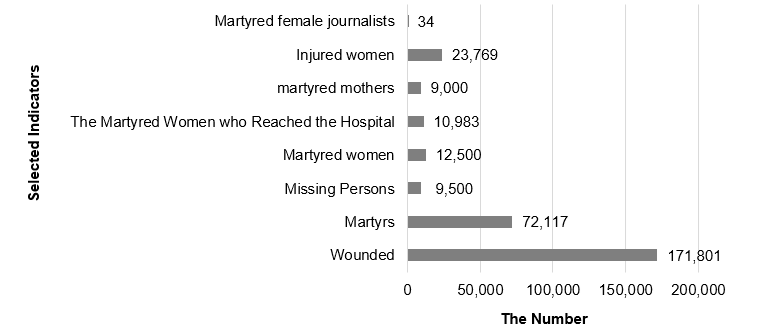
Figures released by the Palestinian Ministry of Health showed the unprecedented scale of the humanitarian catastrophe that has befallen the Palestinian people since October 7th, 2023. As of March 4th, 2026, 72,117 Palestinians have been martyred in Gaza Strip. Women have borne a particularly severe share of these losses, with more than 12,500 women martyrs, including 10,983[1] who were brought to hospitals by December 31st, 2025. The number of martyred mothers has exceeded 9,000, representing a direct blow to the core of the Palestinian household and its social fabric. In addition, 34 women journalists have been martyred, indicating that women have also been targeted in their professional and media roles.
The consequences of the aggression do not end there. Women and children constitute more than 40% of the 171,801 injured on March 4th, 2026, while 9,500 remain missing under the rubble, the vast majority of whom are women and children. Direct injuries to women since the start of the Israeli aggression are estimated at approximately 23,769 cases[2], many of whom suffer permanent disabilities, psychological trauma, and repeated displacement, in addition to bearing the burden of caring for their households under harsh conditions. The aggression also resulted in the repeated displacement of more than two million people within Gaza Strip, nearly half of whom are women, in extremely harsh humanitarian conditions.
In parallel, the Israeli occupation continued its aggression in the West Bank, which has led to the martyrdom of 1,121[3] Palestinians, including 23 women, as a result of attacks by the Israeli forces and settlers. This reality confirms that the Palestinian women are still at the heart of the targeting and are paying a heavy price in the battle for survival and existence March 4th, 2026.
Selected Indicators of the Israeli Aggression against Gaza Strip Since October 7th, 2023– February 24th, 2026
Palestinian Women in Israeli Prisons: Arrest, Torture, and Slow Execution
A report issued by prisoners' rights organizations[4] reported that 2025 witnessed widespread arrest campaigns in the West Bank, alongside field interrogations that dominated the scene. The report documented more than 7,000 arrests during 2025, including 200 women[5]. As of February 5th, 2026, the number of prisoners and detainees in Israeli occupation prisons exceeded 9,350, including 53 female prisoners, two of whom were children. All of them are subjected to a comprehensive system of systematic abuse and torture. In Gaza Strip, accurate information is unavailable due to the crime of enforced disappearance that the Israeli occupation continues to perpetrate against female detainees in Gaza Strip.
Women Pay the Highest Price: 22,057 Widows and an increase of 50% in Female-Headed Households
Since October 7th, 2023, Palestinian women in Gaza Strip have faced a harsh reality, with 22,057 women losing their husbands and becoming widows, an alarming indicator of the scale of the humanitarian tragedy and the profound social consequences of the Israeli aggression. This human loss has led to a radical transformation of the social and economic structure in Gaza Strip. The percentage of female-headed households rose from 12% during the first nine months of 2023 to around 18% during the period of the Israeli aggression (September – October 2025), an increase of 50%. Women alone bear the burden of supporting their households, caring for children, and filling the void left by the absence of the primary breadwinner amid a total economic collapse. As a result, these circumstances place women under escalating economic, social, and psychological pressures, with loss of income, erosion of support networks, and increased vulnerability under harsh living conditions.
Gaza Strip without Work: The Economy Is Paralyzed and Unemployment Is Rampant Under the Weight of the Aggression
The labor market in Gaza Strip is suffering from an almost complete collapse due to the aggression, showing deep structural imbalances with a clear gender dimension. Although the female labor force participation rate remained at 17% (September – October 2025), the same level as in Q3 2023 before the Israeli aggression, this apparent stability conceals a reality closer to forced exclusion, amid a lack of actual employment opportunities. In contrast, male participation sharply declined from 63% to 31% due to the paralysis affecting various economic activities. The most severe shock is reflected in unemployment rates, which reached 92% among women in the labor force compared to 81% among men, indicating compounded vulnerability for women in times of crises. These repercussions extend to highly educated groups, with unemployment among youth (aged 19–29) holding a diploma or higher reaching 79%, specifically 86% for women compared to 70% for men, highlighting a widening gender gap and the erosion of educational returns for young women, even at higher education levels.
When Homes Turn to Rubble: The Tragedy of Displacement in Gaza Strip and the West Bank
In Gaza Strip, the Israeli aggression caused widespread destruction, completely destroying around 268,000 housing units and severely damaging 148,000, in addition to partially affecting 153,000 units. This displacement has left over 288,000 households without homes. Estimates indicate that at least two-thirds of the population (1.4 million out of 2.1 million people) are living in over a thousand sites[6], most in dilapidated tents or overcrowded, unsafe shelters lacking privacy and basic living necessities. Women and girls bear the heaviest burden in these conditions of extreme overcrowding and absence of privacy, which exacerbates risks of violence and deprives them of access to healthcare.
Since the beginning of 2025, Israeli military operations have forced thousands of Palestinians in the northern West Bank camps (Jenin, Nur Shams, and Tulkarm) and their surrounding areas into forced displacement, imposing harsh living conditions and leaving the possibility of return uncertain. The military operations escalated from limited raids to prolonged campaigns, resulting in the displacement of approximately 50,000 refugees, according to estimates by the United Nations Relief and Works Agency for Palestine Refugees (UNRWA). Data indicate that around 27,500 Palestinians were displaced from the Tulkarm and Nur Shams camps and surrounding areas, with most settling in Tulkarm city and its villages, while about 21,000 people from Jenin camp were displaced to the American University housing, city neighborhoods, and 39 towns and villages across the governorate. This reality not only violates human dignity but turns life itself into an existential threat, particularly for children and women in an environment crushed by loss and ongoing displacement.
The Catastrophic Collapse of the Health Sector: Depriving Women in Gaza Strip of Their Right to Life and Specialized Care
The Israeli aggression against Gaza Strip since October 7th, 2023, has led to an almost total collapse of the health system, with approximately 94% of healthcare facilities damaged or destroyed. This has resulted in a sharp decline in maternal, child, emergency, and specialized care services, rising rates of miscarriage, and difficulties in accessing healthcare for pregnant women. Moreover, around 37,000 pregnant and breastfeeding women[7] experience severe malnutrition between October 2025 and October 2026, posing serious risks to the health of mothers and children. Maternal malnutrition contributes to low birth weights, increasing health risks before and after birth, and threatening the growth and well-being of children.
Maternal mortality has risen to 145 deaths per 100,000 live births in 2024, compared to 17.4 in 2022, reflecting the collapse of health services and the lack of safe care for pregnant women.
Regarding women’s health, breast cancer accounts for approximately 30% of all cancer cases among women, with a rate of 29 cases per 100,000 women[8]. For the second consecutive year, women are deprived of early detection and treatment services due to the destruction of primary care centers, diagnostic imaging units, and the absence of radiotherapy, compounded by worsening malnutrition that further complicates their health conditions.
The West Bank Labor Market: Women's Participation Progresses, but Rights Lag Behind
Labor Force Survey data for the fourth quarter of 2025 showed that only 19% of women of working age participate in the labor force, with an unemployment rate of 27% among them. In comparison, 72% of men of working age participate in the labor force, with an unemployment rate of 28%. However, the situation appears more dire among young people (aged 19–29) with a diploma or higher, where the unemployment rate reached 38% (45% for females compared to 28% for males). This reflects the continued structural challenges facing educated young women in integrating into the labor market.
The challenges don't stop at employment; they extend to the quality of work and legal protection in the private sector. Data from the fourth quarter of 2025 indicate that female workers are subjected to clear wage discrimination, with 31% of women earning less than the minimum wage (1,880 shekels), compared to only 10% of men. Furthermore, approximately 30% of female employees lack formal employment contracts, and more than half (53%) are denied basic rights such as paid maternity leave or end-of-service benefits. This situation places women in the West Bank between the hammer of educational unemployment and the anvil of precarious and exploitative work, weakening their economic resilience under the current circumstances. This reflects the inadequacy of the social protection system and the lack of fair wages for women in the labor market.
Women’s Participation in Local Councils: April 2026 Elections
With the April 2026 local elections approaching, the need to strengthen women’s representation in local governance is clear. Women hold only 1% of council heads and 21% of membership in the West Bank in 2024[9], highlighting a significant leadership gap. This election represents an opportunity to enhance their participation and empower them to play an active role in local decision-making.
[1]https://app.powerbi.com/view?r=eyJrIjoiODAxNTYzMDYtMjQ3YS00OTMzLTkxMWQtOTU1NWEwMzE5NTMwIiwidCI6ImY2MTBjMGI3LWJkMjQtNGIzOS04MTBiLTNkYzI4MGFmYjU5MCIsImMiOjh9
[2] Palestinian Ministry of Health, 2025
[3]Shireen Abu Akleh Observatory (Updated as of 04/032/2026) https://www.shireen.ps/home
[4]Includes Commission of Detainees and Ex- Detainees affairs, the Palestinian Prisoners Club, Addameer Prisoner Support and Human Rights Association.
[5]The number of arrests includes both those who are still detained by the Israeli occupation and those who were released later on.
[6]Humanitarian Situation Update #357 | Gaza Strip | United Nations Office for the Coordination of Humanitarian Affairs - Occupied Palestinian Territory
[7] https://www.ipcinfo.org/fileadmin/user_upload/ipcinfo/docs/IPC_Gaza_Strip_Acute_Food_Insecurity_Malnutrition_Oct2025_Apr2026_Special_Snapshot.pdf
[8] https://www.ochaopt.org/ar/content/humanitarian-situation-update-329-gaza-strip
[9] Ministry of Local Government. 2025. Ramallah – Palestine.