 عربي
عربي
H.E. Dr. Ola Awad, President of Palestinian Central Bureau of Statistics (PCBS), Presents the following:
· The Performance of the Palestinian Economy during 2025.
· The Economic Forecasts for 2026.
The Palestinian economy is still deeply mired in recession during 2025.
Although the Palestinian economy recorded a marginal increase of 4% in 2025 compared to 2024, the GDP continues to show prolonged recession, where it declined by 24% compared to 2023. This decline reflects the scale of the cumulative damage inflicted on the economy since the start of the Israeli occupation aggression on the West Bank and Gaza Strip, which led to the deterioration of productive capacity and the persistence of bottlenecks in economic activities.
During 2025, GDP recorded a sharp decline in Gaza Strip, reaching 84% compared to 2023, while it declined by 13% in the West Bank during the same period. Even though GDP in the West Bank recorded a slight increase of 4.4% in 2025 compared to 2024, GDP in Gaza Strip continued to contract, where if further declined by 8.7% during the same period.
The growth rate recorded in 2025 is mainly attributed to a relative improvement in some productive sectors and the partial return of commercial activity compared to 2024. However, the level of GDP in Palestine remains far below its pre-Israeli aggression levels, confirming that the Palestinian economy has not yet regained its productive capacity and that the road to recovery remains fragile and constrained by the repercussions of the Israeli aggression and the ongoing restrictions.
GDP by Region, 2020- 2025 at Constant Prices: Base Year 2015
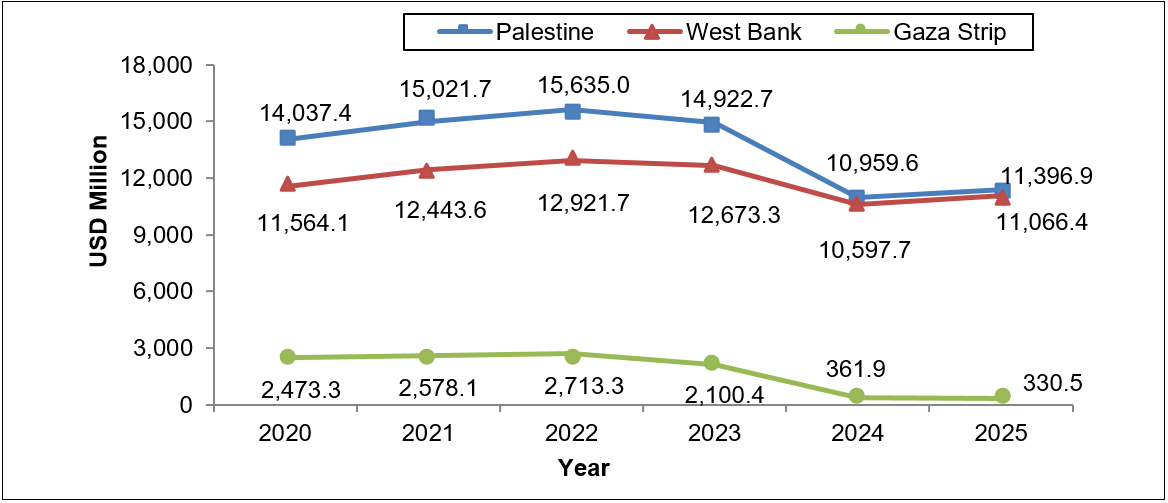
A complete collapse of all economic activities in Gaza Strip during 2025 compared to 2023, along with a sharp decline in economic activities in the West Bank, despite their increase compared to 2024.
The Palestinian economy is considered a service economy, where 60% of the Palestinian economy is services, while the productive sectors that support economic growth constitute only about 19% of the total economy. This indicates that the Palestinian economy is changeable, and is significantly impacted by the challenges.
During 2025, most economic activities in Palestine declined compared to 2023, as the construction activity recorded the highest decline, reaching 41% (29% in the West Bank, and 99% in Gaza Strip) to reach USD 296 million, followed by the industrial activity with a decline of 25% (21% in the West Bank, and 94% in Gaza Strip) to reach USD 1,155 million, then the services activity declined by 25% (12% in the West Bank, and 82% in Gaza Strip) to reach USD 6,794 million, and agriculture activity with a decline of 18% (stable in the West Bank, and 92% in Gaza Strip) to reach USD 686 million.
In 2025, most economic activities showed marginal increases that do not indicate the beginning of recovery of the Palestinian economy’s sectors compared to 2024. Most of economic activities remain about one-third below their pre-Israeli aggression levels.
Percentage Contribution* of Economic Activities to GDP in Palestine, 2025 at Constant Prices (Base Year 2015)
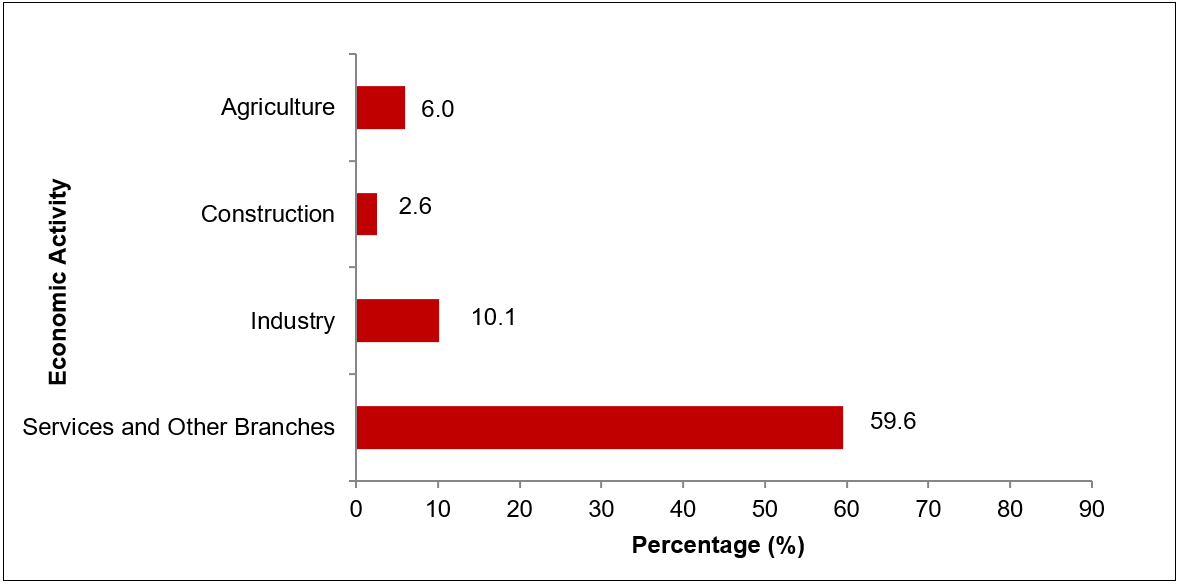
(*) The summation of percentages does not equal 100 due to exceptions in adjustment items.
A decline in the trade volume from and to Palestine in 2025 compared with 2023
The volume of trade exchange between Palestine and the outside world witnessed a 12% decline. The value of imports fell by 17%, totaling USD 7,881 million in 2025 compared to 2023. Additionally, Palestinian imports make up more than three times the value of Palestinian exports. However, the value of exports of goods and services from Palestine increased by 5%, reaching USD 2,856 million, where this rise is attributed to the fact that most Palestinian exports come from the West Bank, which recorded a relative increase during the same period. In a sense, this reflects a steady deficit in the Palestinian balance of trade. Exports and imports increased by 18% and 20% in 2025, respectively, compared to 2024, while they remain below their pre-Israeli-aggression levels. It is important to note that the largest share of trade exchange with the outside world in Gaza Strip was recorded in 2003, at 29% of total Palestinian trade. However, this percentage has since declined to less than 4% during Israeli occupation aggression, due to the near-total disruption of supply chains into and out of Gaza Strip. This disruption led to a health and food crisis, with basic commodities, medicines, health supplies, and food provided at minimal levels, not exceeding 4% of the necessary quantities required in the Gaza Strip.
Trade Balance of Goods and Services in Palestine, 2020- 2025 at Constant Prices (Base Year 2015)
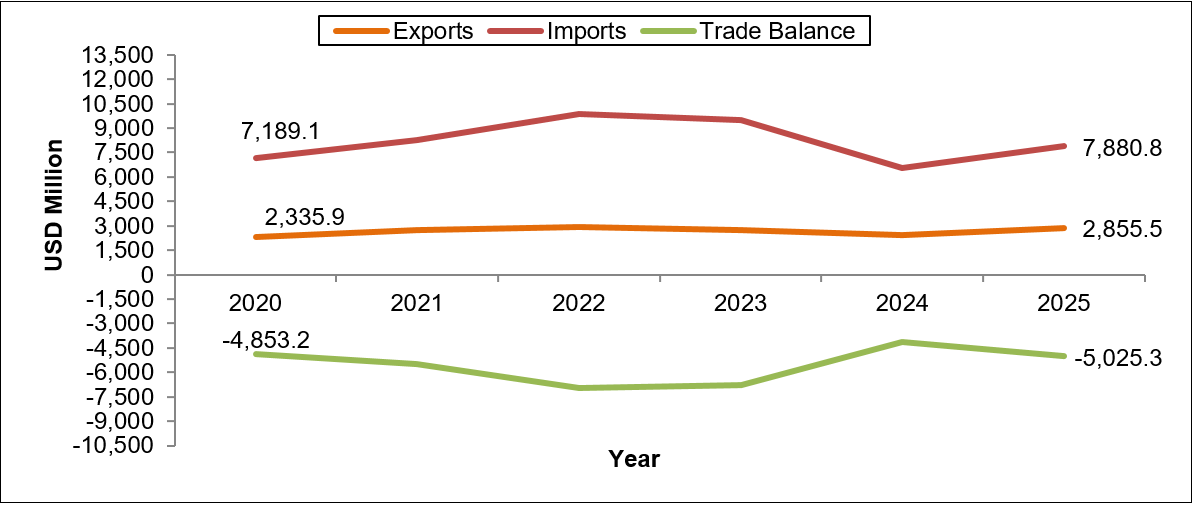
The Unemployment Rates in Gaza Strip Exceed 77% in 2025
The Palestinian labor market continues to face difficult challenges in light of the ongoing economic and social impacts of the Israeli aggression on Gaza Strip. Despite the slight improvement in unemployment and labor force participation indicators during 2025, the figures still reflect a state of recession and a sharp disparity between the West Bank and Gaza Strip.
About half of the labor force in Palestine was disrupted, where the unemployment rate reached 46% in 2025 (28% in the West Bank and 78% in Gaza Strip). This reflects the high unemployment rates in the West Bank and Gaza Strip, despite the slight changes in these rates, where the total number of unemployed individuals reached more than 650 thousand.
Despite this difficult reality, labor force participation rate increased in 2025 to 43.7%, partly due to individuals attempts to engage in any form of work or seek alternative livelihood opportunities after the Israeli aggression. The participation rate reached 43% in the West Bank, while it reached 38% in Gaza Strip, where such percentages are below the pre-Israeli aggression levels recorded in 2023.
Unemployment Rate by Region, 2020- 2025
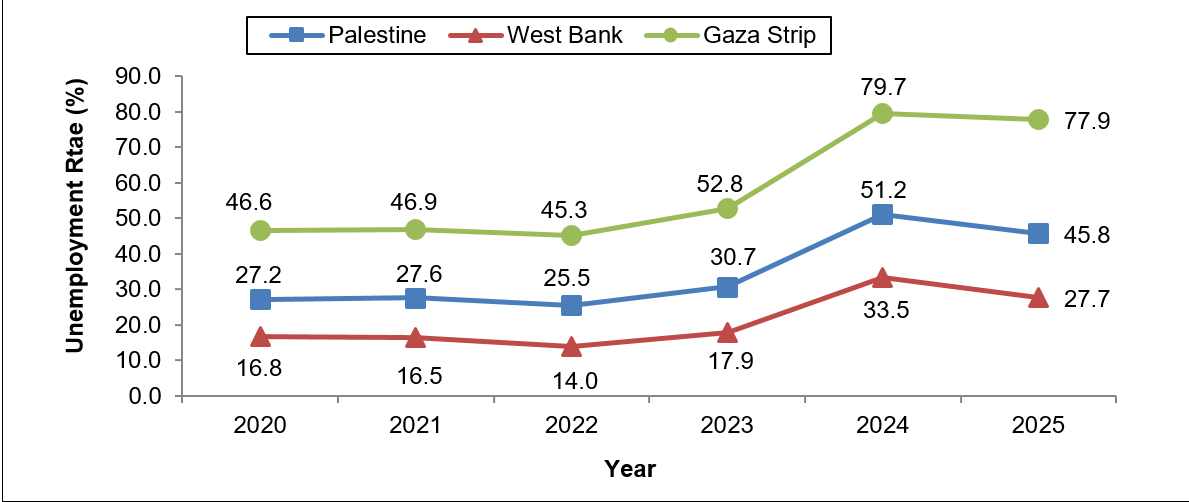
Poverty and Living Standards
Unprecedented Increase in Prices Levels
At the level of prices in Palestine during 2025, prices increased by about 11% compared to 2024, due to the sharp rise of prices in Gaza Strip of around 22%, despite their slight decline in the West Bank of about 0.13%. The near-total blockade on Gaza Strip continued, leading to a severe shortage of goods entering to Gaza Strip, in addition to the regional situation that affected Palestine.
Economic Forecasts for 2026
Those forecasts were developed based on various scenarios for Palestine, and in consultation with the Advisory Committee for Economic Statistics, which consists of local economists and academics, in addition to the Ministry of Finance, Ministry of National Economy and the Palestinian Monetary Authority. Each scenario took into consideration internal political, economic circumstances for 2026, Israeli aggression against Gaza Strip, foreign aids, Israeli occupation measures against Palestine, the number of Palestinian employees in Israel and the economic and social variables.
First: Baseline Scenario:
This scenario is based on the continuation of the current political and economic situation in Gaza Strip, without having any prospect for resolving all life issues in Gaza Strip,. It is an extension of the current situation during the fourth quarter of 2025. According to this scenario, the Palestinian economy will continue to face severe restrictions on trade movement and crossings due to the massive destruction caused by the Israeli aggression, in addition to a significant disruption in the movement of the Palestinian labor into Israel. The features of this scenario are concentrated among a set of key assumptions, where this scenario assumes the following:
1. The Israeli occupation continues to impose closures between the West Bank governorates, restricting the movement of individuals and goods to and from Palestine. This includes a suspension of work permits for Palestinian workers in Israel and Israeli settlements, maintaining the minimum levels observed in 2025.
2. The unjust deductions of most of clearance revenues by the Israeli occupation, which will negatively impact the Palestinian Government's ability to meet its obligations to the public sector and private suppliers.
3. A decrease in income and value-added tax revenues (both local and clearance) occurs due to the dismissal of most Palestinian employees working in Israel and Israeli settlements, as well as the ongoing economic recession.
4. External aid supporting the Palestinian budget and society remains consistent with its levels in 2025.
5. The implementation of externally funded development projects continues as planned.
Baseline Scenario Expectations:
Based on this scenario, GDP is expected to rise by 4.1% in 2026 compared to 2025, leading to an increase of 1.8% in GDP per capita. Additionally, gross consumption (private and public) is expected to increase by 3.7% compared to 2025.
At the level of economic activities, the value added of construction activities is expected to increase by 23.2%, industry activities by 6.5%, agricultural activities by 6.4%, and service activities by 1.2% in 2026 compared to 2025.
Work and Workers: The unemployment rate is expected to reach 43.1% in 2026 compared to 45.8% in 2025.
Second: Recovery and Reconstruction Scenario:
This scenario is based on the end of the Israeli aggression on Gaza Strip and the implementation of the terms of the ceasefire agreement, which including the continuous and permanent entry of aids, starting reconstruction, and the subsequent measures in the West Bank.
It also involves the gradual return of the political situation as it was before the Israeli aggression on Gaza Strip, as well as the gradual recovery of the economic situation to ensure the availability of basic living necessities in Gaza Strip. This scenario also encompasses the restoration of the economic situation in the West Bank to its pre-October 7, 2023, conditions. The key features of this scenario are based on the following assumptions:
1. Reducing the restrictions and checkpoints imposed by the Israeli occupation between the governorates of the West Bank on the movement of individuals and goods to and from Palestine. In addition, the start of gradual return of workers to work in Israel and Israeli settlements.
2. An increase in external aid to support the reconstruction of the Gaza Strip, including the inflow of essential in-kind and cash inputs needed to rebuild and restore infrastructure. This also includes the provision of immediate aid to facilitate a gradual recovery of production throughout 2026.
3. Releasing the clearance revenues withheld by the Israeli occupation and the commit to regularly transfer them. This is expected to positively impact the government’s ability to meet its obligations to public sector employees and private sector suppliers.
4. An increase in banking sector profits driven by a rise in credit facilities resulting from an improved economic situation.
5. A gradual rise in income and value-added tax revenues (both local and clearance) as economic conditions and reconstruction efforts improve, contributing to the recovery of the Palestinian economy.
6. An increase in the volume of foreign aids supporting the Palestinian budget.
Recovery and Reconstruction Scenario Expectation:
Based on this scenario, GDP is expected to increase by 15.0% in 2026 compared to 2025, resulting in an increase of 12.5% in GDP per capita. Additionally, gross consumption (both private and public) is anticipated to rise by 10.6% compared to 2025.
At the level of economic activities, the value added of construction activities is anticipated to grow by 51.2%, agricultural activities by 4.8%, industrial activities by 3.2%, and services activities by 2.1% in 2026 compared to 2025.
Work and Workers: The unemployment rate is expected to decline to reach 41.8% in 2026 compared to 45.8% in 2025.
Third: The Pessimistic Scenario
This scenario is based on a deterioration in the political and economic situation in the State of Palestine due to the breach of the ceasefire agreement by the Israeli occupation in Gaza Strip, which includes the failure to implement the terms of the agreement, in addition to an increase in the restrictions imposed on the West Bank through more settlers attacks. The features of this scenario are based on a range of assumptions, including:
1. Imposing additional closures and restrictions by the Israeli occupation on the movement of individuals and goods between the governorates of the West Bank and Gaza Strip, including the near-complete closure of crossings As well as the suspension of work permits for workers in Israel and Israeli settlements.
2. The continuation of the complete and unjust deductions of the clearance revenues by the Israeli occupation. This will negatively affect the government’s ability to fulfill its obligations to the public sector and private suppliers.
3. A significant decrease in income and value-added tax revenues (local and clearance) due to repeated Israeli invasions of Palestinian governorates and the destruction of the infrastructure of establishment and factories.
4. The level of external aid to support the Palestinian budget remains at minimal levels, as it was in 2025, along with a minimal flow of humanitarian aid to the Gaza Strip
5. A complete suspension of development projects, along with reduced support for small businesses and microenterprises.
6. The imposition of additional restrictions on the banking sector due to the Israeli occupation’s practices affecting banking relations between the two sides.
The Pessimistic Scenario Expectations:
Based on this scenario, GDP is expected to contract by 4.2% in 2026, along with a decrease of 6.3% in GDP per capita. Additionally, gross consumption (private and public) is anticipated to rise by 2.5% compared to 2025.
At the level of economic activities, the value added of agricultural activities is anticipated to decrease by 20.2%, industrial activities by 8.2%, construction activities by 3.2%, and services activities by 1.3% in 2026 compared to 2025.
Work and workers: The unemployment rate is expected to increase to reach 47.8% in 2026 compared to 45.8% in 2025.